Oct. 28, 2026 · 10 min read
What neighbors told city and county leaders about data centers
About 180 people packed Tuesday's joint meeting of the Sioux Falls City Council and Lincoln County Commission. Officials spent an hour listening in small circles, then said what they heard. Here's the recap, with links to every moment in the video.
On Jan. 6, I was at City Hall the night the City Council rezoned land in northeast Sioux Falls for a hyperscale data center. Hundreds of neighbors filled the room. The council heard them, then approved it.
I wasn't able to be there Tuesday night, and I regret that. This was the next big step in the conversation that started that night.
When I heard there was a recess in the middle, a full hour for officials to sit with neighbors and listen, I knew I had to go back, rewatch the meeting and follow up. I came away heartened. It looked like the process moving forward, with more people let in.
Here's what happened, and what was said. Every quote below links to the exact moment in the City's video, so you can hear it for yourself.

A different kind of meeting
The Sioux Falls City Council and the Lincoln County Commission met together on Tuesday, Oct. 27. No decisions were on the table. The goal was to listen and learn.
Council Chair Rich Merkouris said the hope was "that we could listen and learn from one another and have open dialogue and conversation" (0:07:56). He credited Rep. Greg Jamison of District 12 with the idea for the format (0:07:27).
The night had three parts:
- Two short presentations on what data centers are and what the zoning rules say today.
- A 60-minute recess. About 175 to 180 people pulled their chairs into circles of 10 to 15 (0:39:06). Councilors and commissioners moved from circle to circle, with three questions to get people talking.
- Report-back and public comment. Officials shared what they heard. Then anyone could speak for three minutes.
The small-group talks weren't recorded. Everything else was.
What we learned about data centers
Dr. Brent Van Aartsen, chief technology officer at Dakota State University, gave the overview. He said he was there to share facts, not a position.
"A data center is not simply a warehouse full of computers," he said (0:09:49). Inside are rows of servers, plus the power, cooling and security systems that keep them running.
His main point: the labels get mixed up. "The terms AI data center, hyperscale, and co-location should not be treated as synonyms," he said (0:13:21).
What the rules allow today
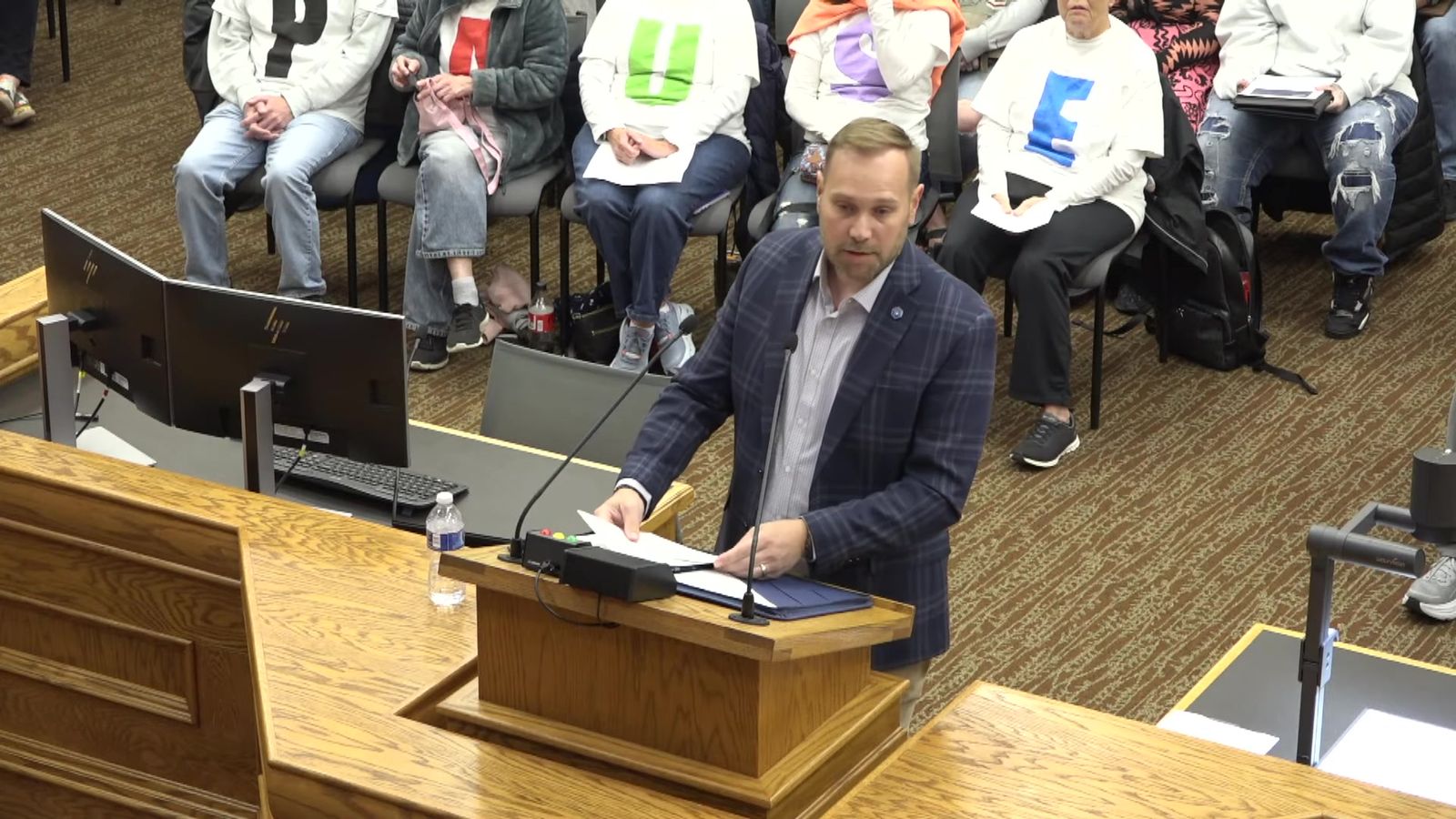
Inside Sioux Falls, data centers are allowed in light and heavy industrial zones, said Jason Bieber of the City's planning office. If a project meets a short list of standards, like keeping trucks off neighborhood streets and keeping everything inside the building, it can be approved without a public hearing. If it can't meet them, it needs a conditional use permit, with a hearing at the Planning Commission that can be appealed to the City Council (0:27:29).
Commissioner Joel Arends asked where else a project the size of Gemini could go. Bieber said the Gemini site is about 140 acres, and there aren't many large industrial areas left besides Foundation Park, with some near Benson Road and I-229 (0:32:31).
In the joint jurisdiction area, the land just outside the city that Sioux Falls and Lincoln County plan together, data centers are only allowed in industrial zones, said Toby Brown, Lincoln County's planning director. And the plan both bodies adopted, Shape Sioux Falls 2050, shows no new industrial land there. "Essentially there's no new areas that would be allowed for this type of a land use," he said (0:31:23).
In plain words: a data center there would first need the land rezoned. Councilor Sara Pankonin asked to confirm that, and staff said "correct" (0:37:15).
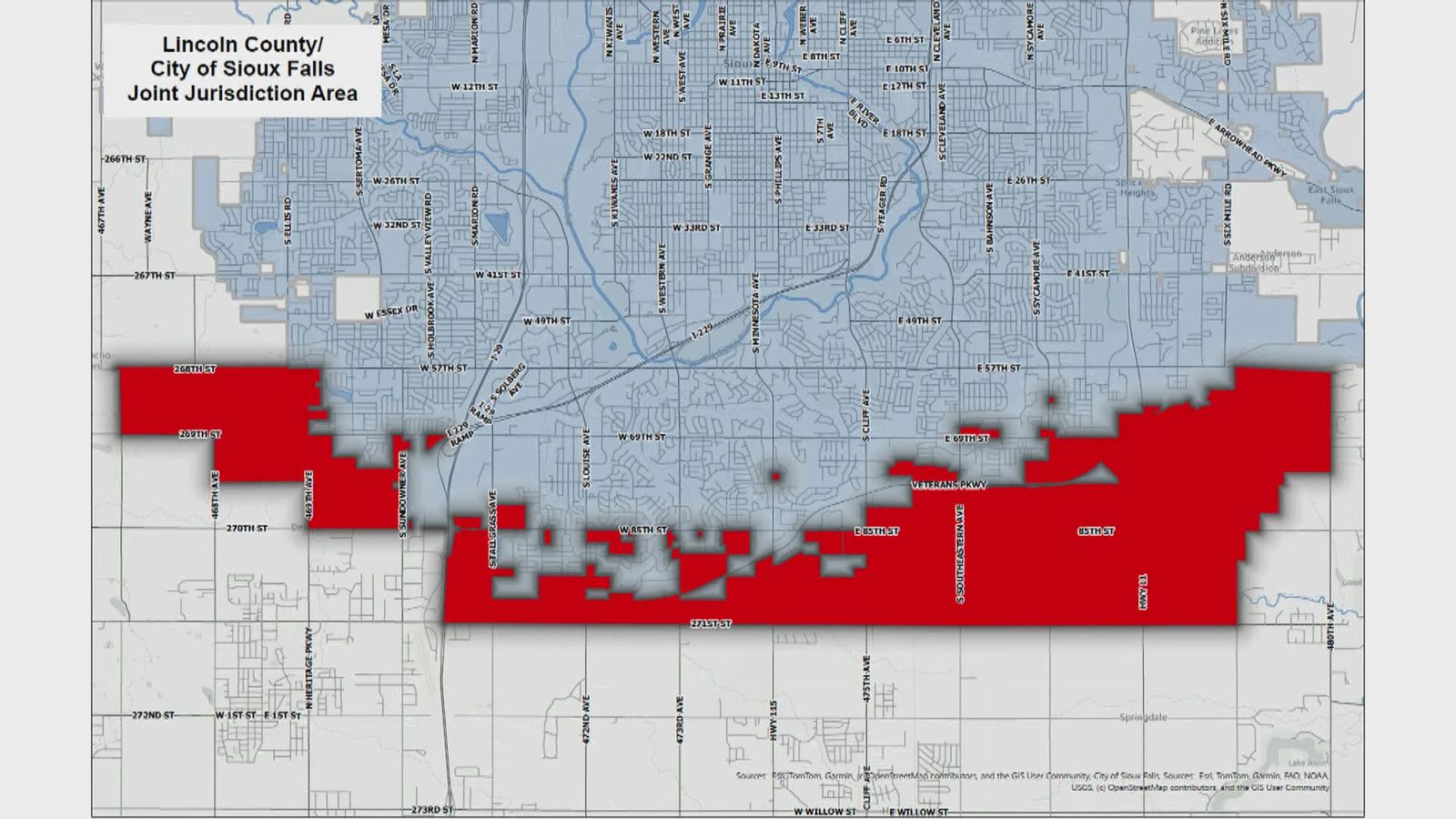
The joint jurisdiction area, in red. Slide from the City and Lincoln County presentation.
What officials heard in the circles
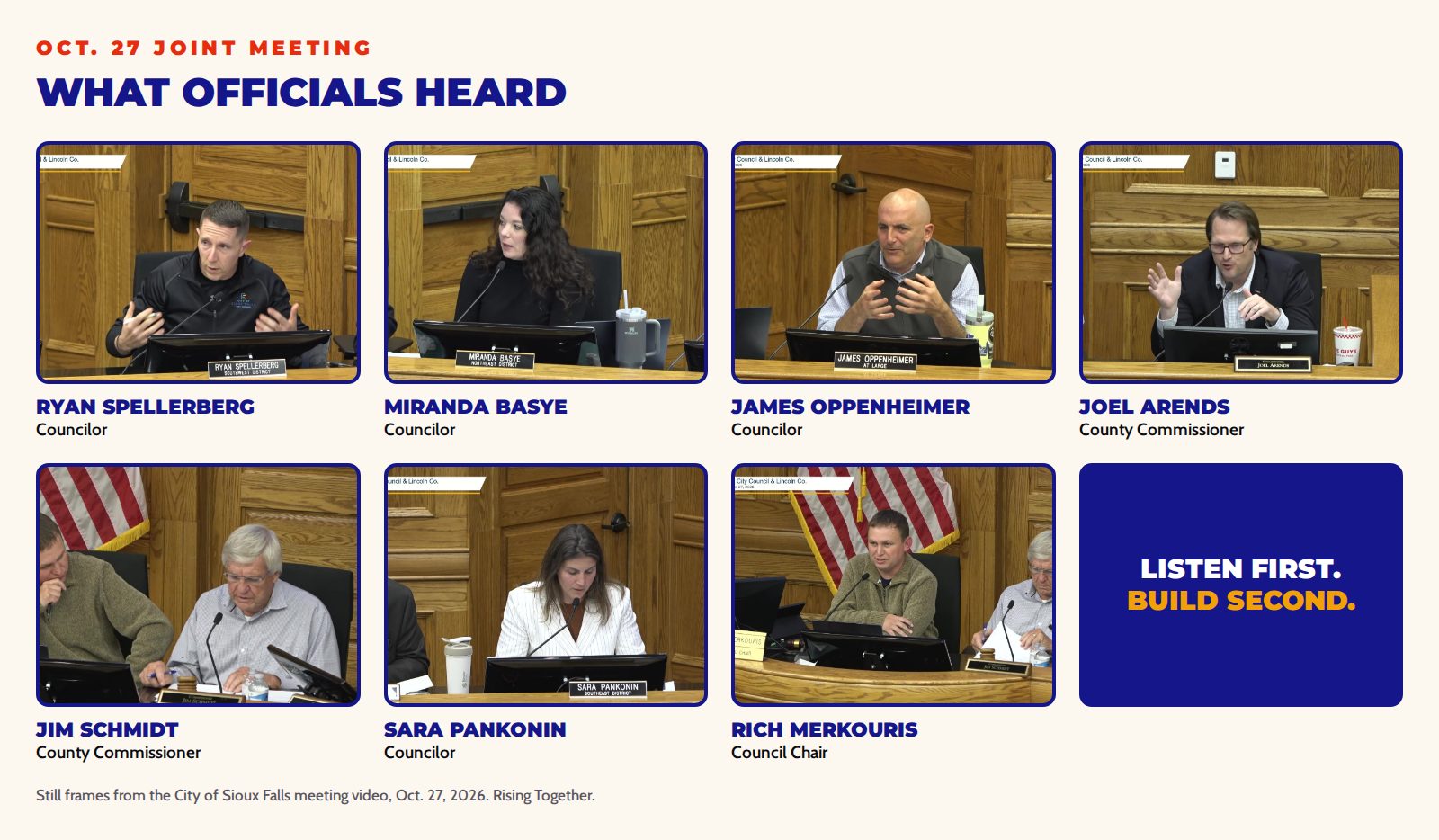
After the recess, most of the officials spoke. A few themes came up again and again: who benefits, who's accountable, and whether the rules can be written in time.
Councilor Ryan Spellerberg: "The overwhelming question was how does this benefit me if this project goes through?" He also wants to look at surety bonds, so a site could be cleaned up if a company leaves (1:49:41).
Councilor Richard Thomason heard people ask who the end user will be, and "what protections are there to ensure that whatever they say they're going to build is going to be built" (1:50:03).
Councilor Miranda Basye said her groups were "kind of split." Some saw a path to community benefits if it's done right. Others weren't convinced (1:51:24).
Councilor James Oppenheimer: "It's very different to sit down one on one with people and talk compared to getting emails or hearing people at the dais" (1:53:22). The people he spoke with, he said, are "very much not in favor."
Commissioner Joel Arends heard "broad, bipartisan, outright opposition to data centers" (1:56:37). He also pointed out that Brandon neighbors near the site "don't get to vote for who the Sioux Falls City Council is" (1:59:32). Some people told him a small data center they never notice is fine. "I can live with that, but I can't live with U.S. Bank Stadium" (2:02:01).
Commissioner Jim Schmidt took away "the process itself. The process of transparency, the process of information, the process of education" (2:05:49).
Councilor Sara Pankonin asked people for one word for their biggest concern. She heard environment, cost, health, noise, transparency, accountability and more (2:07:50).
Chair Rich Merkouris summed it up in two ideas: accountability, and "laser focused zoning" that doesn't hurt other light industry (2:09:05).

Councilor Jennifer Sigette noted her circles mostly talked about Gemini, not the joint jurisdiction area (1:52:11). Merkouris answered that the two connect: that area will be annexed into the city one day, so its rules should line up with the city's, with no "cliff" between them (2:10:08).
What people said at the microphone
About two dozen people spoke during public comment. Most asked for a pause on permits, a moratorium, until rules are written. A few asked for an outright ban. One speaker said he doesn't support a pause.
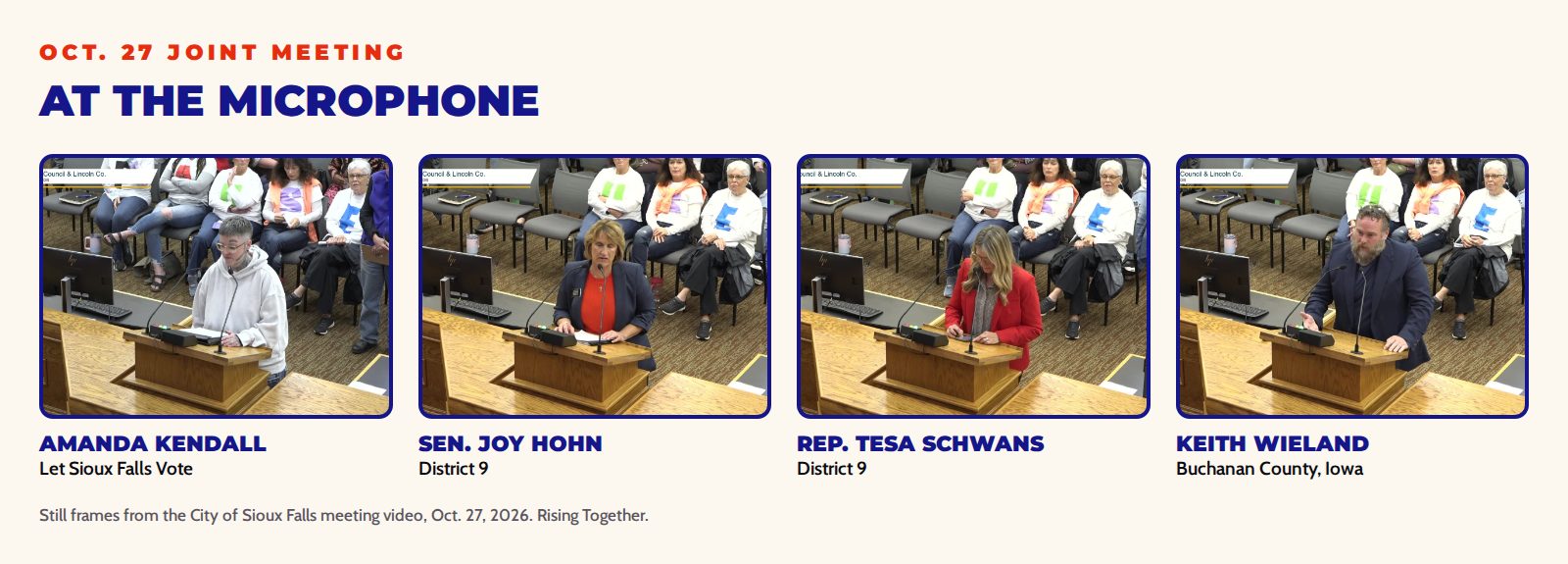
Amanda Kendall of Let Sioux Falls Vote: "How are we supposed to write regulations that protect our community when we haven't had enough time to fully understand what we're regulating?" (2:14:21). She said 865 people have signed the coalition's letter asking for a temporary moratorium.
State Sen. Joy Hohn, District 9, pointed to the state's new data center law. It keeps the state from overriding local rules, she said, so "those protections must be done by local governments" (3:12:39). She asked for "a temporary pause, a moratorium" (3:13:44).
State Rep. Tesa Schwans, District 9, agreed: "it's the responsible approach to possibly consider a moratorium before passing any strong ordinances" (3:15:33).
A Sioux Falls resident who said he has spent over 30 years leading technology teams took the other side. "A moratorium doesn't add protection. It adds a stop sign," he said (3:10:06). He asked the council to turn the conditions placed on Gemini into a standing ordinance, so every project starts from the same rules.
Keith Wieland, a county supervisor from Buchanan County, Iowa, shared what his county did with an 800-megawatt proposal. They paused, and are now on their second draft of rules. Even with the tax money on the table, he said, "they didn't care. They didn't want the data center" (3:20:28). His advice: "Listen to your constituents" and write their concerns into the ordinance (3:21:24).
People raised low-frequency noise, water, power lines, property values, taxes and transparency. And they talked about the format itself. One resident called the night great and asked for more of it, "like once a month, on everything" (2:25:23). Another wanted the circle conversations said at the microphone, so they'd be part of the public record (2:17:17).
Both points are fair. The format let more people be heard. The record should catch what they said.
What happens next
The City Council's committee on data center rules picks it up from here. It's made up of Council members Sara Pankonin, James Oppenheimer, Ryan Spellerberg and Rich Merkouris. Merkouris walked through the timeline (2:11:33):
- Monday, Nov. 9, 6 p.m.: Committee meeting at Carnegie Town Hall, 235 W. 10th St.
- Friday, Nov. 27: Last day to send the committee proposed rules or materials.
- Monday, Nov. 30, 6 p.m.: Committee meeting at Carnegie Town Hall.
- Monday, Jan. 4, 6 p.m.: Committee meeting at Carnegie Town Hall.
- Tuesday, Jan. 12: The committee reports to the full council.
The meetings are public, and any councilor or commissioner can attend. Send your comments at siouxfalls.gov/ROC. The City also asked for feedback on whether Tuesday's format was helpful.
New to all this? Start with my explainer, Data centers in Sioux Falls, and how to have your say.
I said in January that my biggest frustration was the order of things. Listen first. Build second. On Tuesday, the order looked right. Now let's keep showing up while the rules get written.
Read the full transcript
Download our cleaned-up transcript, with speaker names and timestamps. It was made from an automatic transcription of the City's video and lightly edited, so it's not an official record. Quotes in this post were checked against the recording, but click through to hear the exact words. The City's official minutes will be posted at amv.siouxfalls.gov.
Sources
- Joint Sioux Falls City Council and Lincoln County Commission meeting video, City of Sioux Falls, Oct. 27, 2026
- Meeting agenda, City of Sioux Falls
- City Council announces committee to review data center regulations, City of Sioux Falls, Oct. 13, 2026
- Brent Van Aartsen, Chief Technology Officer, Dakota State University
Photos are still frames from the City of Sioux Falls meeting video.

Have a tip or a story idea? Email issues@risingtogethersf.com.